Posts

Showing posts with the label APIs

API Trends for 2024: A Glimpse into the Future of Interface Technologies

Image
In 2023, the surge of Generative AI captured most of the spotlight in the tech world. I believe it marked an inflection point not just in how we interact with machines but also in society as a whole. As we move further into 2024, I believe that the API landscape is set to undergo a significant and profound evolution, I believe largely driven by the need to support a diverse array of new use cases emerging from what I like to call the AI Industrial Revolution. This post delves into the top trends in the API landscape, combining insights from my own experiences as an API product executive and practitioner, along with valuable perspectives by other API experts and thought leaders featured in the API Futures  collection. Without further due, following my predictions for 2024: 1) The Rise of Polymorphic Interfaces for AI As Kristof van Tomme said on his article APIs are interface utilities : " As LLM AI systems start consuming APIs, this evolutionary block might get lifted. When AI-dri...

A brief look at the evolution of interface protocols leading to modern APIs

Image
Application interfaces are as old as the origins of distributed computing and can be traced back to the late 1960's when the first request-response style protocols were conceived.  For example,  according to this research, it wasn't until the late 1980's when the first popular release of RPC (described below) was introduced by SUN Microsystems (later acquired by Oracle), that internet-based interface protocols gained wide popularity and adoption. This is perhaps why the term Application Programming Interface (API)  even today can often result in ambiguity depending on who you ask and in what context. This is probably because of the fact that historically the term API has been used to (and to a degree continues to) describe all sorts of interfaces well beyond just web APIs (e.g. REST). This article therefore attempts to demystify (to an extend) the origins of modern web-based APIs. This is done by listing and describing in chronological order (as illustrated below) th...

A comparison of push vs phone-home communication approaches between API Gateways and Management Services

Image
API Gateways  deliver critical runtime capabilities in enterprise-wide API management infrastructures. However, such runtime capabilities must also be complemented with other design-time and governance capabilities in support of activities such as APIs lifecycle management, API design, policy definition and implementation, deployment, retirement, monitoring, and so on. The aforementioned design-time/governance capabilities, are often offered by different API management vendors as a separate M anagement Service infrastructure   that augments/complements the runtime infrastructure (API Gateways). Needless to say in order for runtime and design-time/governance infrastructure to work together cohesively as a collective whole, there must be some sort of effective and reliable communication between these two main components. Whereas some products like for example the  Oracle API Platform Cloud Service , deliver a phone-home approach for API Gateways to communicate with the...

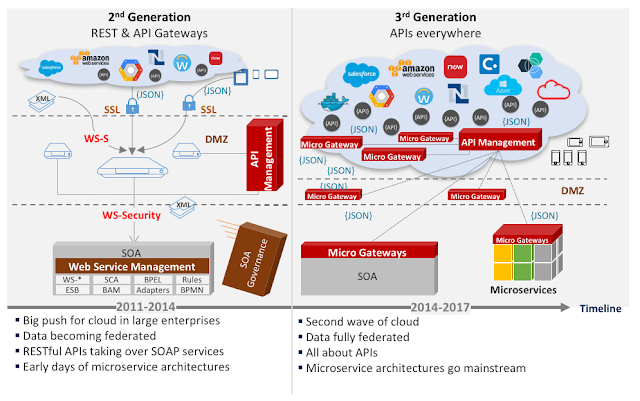
2nd vs 3rd Generation API Platforms - A Comprehensive Comparison

Image
Earlier in the year, June to be exact, I published the OTN article  3rd-Generation API Management: From Proxies to Micro-Gateways  -based on a concept I presented in an Oracle OpenWorld 2016 Presentation titled  API management in the year 2026 . In summary, the article talks about how in the digital era requirements have changed when it comes to getting access to information. Fact that modern applications demand information in real time and expect it to be available 24x7, and also the side effect of cloud adoption which is causing information to become more and more federated amongst multiple cloud applications (from different vendors) and on-premises systems -as they won't go away that easily. The article continues by explaining that although  REST APIs play a critical role in providing such critical access, the underlaying technology stack that have traditionally enabled SOA architectures, typically based on monolithic middleware, will struggle to satisfy...